 Record Reflect Recover
You’ve probably replayed a tough conversation or a stressful moment over and over right after it happened - only to notice that a day later, it feels a little less intense and a bit easier to make sense of. That shift isn’t random. Psychological distance - reflecting later rather than in the heat of the moment - can help you analyze experiences with less emotional reactivity. It supports healthier reappraisal of what happened and gives your brain time to process stress. Here’s what the research says and how you can use it.
Why Reflecting in the Moment Often Increases Stress
When something stressful happens, the brain’s first response is to react, not to reflect. The amygdala and stress systems activate; attention narrows; emotions run high. If you try to “reflect” or “figure it out” immediately, you’re often just rehearsing the same worries or defensiveness. That can deepen rumination and anxiety instead of easing them - so rumination reduction often depends on when you reflect, not whether you do. Many people also find that in-the-moment journaling turns into venting that doesn’t lead to insight - and can even reinforce negative thinking. The fix isn’t to avoid reflection; it’s to time it. Delaying reflection until you have some emotional distance lets different parts of your brain join in: the ones that help you reappraise, see context, and problem-solve. For more on how writing fits in, see What Science Says About Writing Down Stressful Experiences.
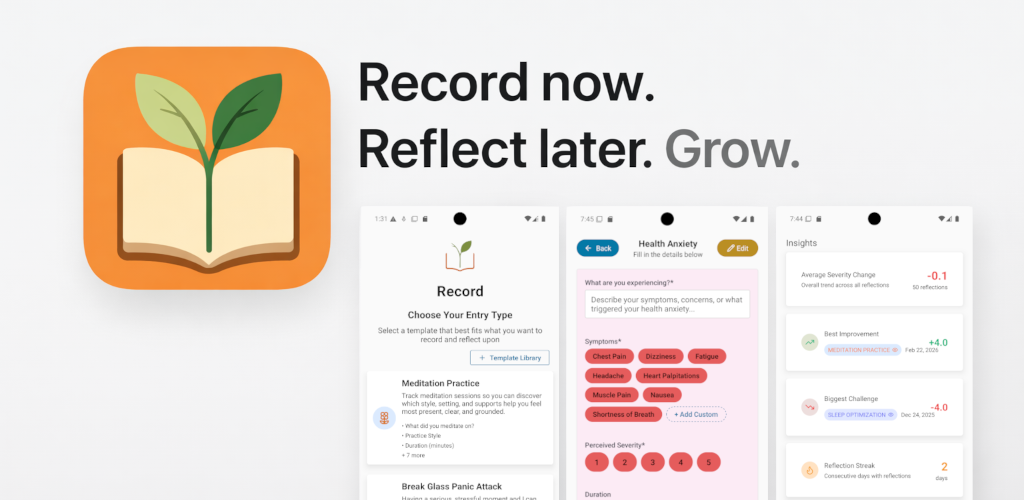
Tools built around the “record now, reflect later” method make this process easier. Record Reflect Recover helps you capture moments quickly and revisit them later with guided reflection.
What the research says about emotional distance and stress processing
Over the past two decades, psychologists have examined how creating psychological distance from an experience - through time, perspective, or language - changes how we process it. In self-distancing and cognitive reappraisal research, this “psychological distance” is the same mechanism: stepping back (in time or in perspective) so that people can analyze experiences with less emotional reactivity rather than being overwhelmed by in-the-moment affect. Temporal distancing (stepping back in time) and self-reflection psychology are central to that effect.
In one influential line of work, Kross and Ayduk (2010) showed that “self-distancing” - stepping back from the self when reflecting on negative experiences - led to more adaptive self-reflection and less emotional reactivity. Participants who reflected from a distanced perspective (e.g., thinking about the situation as an observer) showed better emotional regulation and reappraisal than those who reflected from an immersed, “in the moment” perspective. Emotional regulation research on reappraisal supports this: creating space lets the prefrontal systems involved in reappraisal work instead of being overwhelmed by amygdala-driven emotion.
Expressive writing research adds another piece. Smyth et al. (2008) found that structured expressive writing about traumatic or stressful experiences can improve mood and cortisol reactivity in response to trauma-related stress - though benefits often come when writing supports processing rather than raw venting. Putting experiences into words “later,” with some separation, tends to support that kind of processing. So delayed reflection benefits aren’t just intuitive; they’re backed by work on emotional distance, reappraisal, and written processing of stress.
Practical example: from replay to reappraisal
Imagine a hard conversation at work. In the moment, you might think, “They don’t respect me” or “I messed that up.” If you sit down to reflect immediately, you might just restate those thoughts. But if you capture what happened quickly (a short note or voice memo) and then return to it the next day or later in the week, you often notice: the tone you remembered wasn’t the only interpretation, you had a role in the dynamic too, and there are concrete steps you could take. That’s cognitive reappraisal - and it’s easier with emotional distance.
In Record Reflect Recover, templates make this explicit. The Conflict Processing template lets you record what happened, what you felt, and what you said right after a conflict, then choose “When to Reflect” (e.g., 30 minutes, 4 hours, or 1 day). When the reminder fires, you see your original entry and answer questions like “With distance, did it feel as catastrophic as it did in the moment?” and “What pattern do you notice?” - so you move from rehashing to spotting recurring patterns and repair. The Decision Tracking template works the same way: you log the decision and your reasoning in the moment, then reflect later on actual outcome, possible bias (e.g., fear, sunk cost), and whether you’d make the same choice again. The same principle applies to health anxiety (e.g., Chronic Symptom Flare Tracking), relationship friction (Parenting Reactions, Boundary Setting), or impulse buys (Compulsive Spending): record the raw experience when it’s fresh; reflect later with guided prompts to see patterns and alternatives.
How the Record → Reflect method helps
The Record Reflect Recover app is built around this idea: record now, reflect later. You capture a stressful or significant moment in the moment - with minimal friction, so you don’t lose the detail or talk yourself out of it. Later, when you have emotional distance, the app prompts you to reflect using guided questions. That supports the shift from “what just happened to me” to “what can I learn and what can I do differently?”
Real use cases from the app illustrate the pattern. Social Interaction Energy Tracking has you log who you saw, the setting, and your social stress level at the time; when you reflect (e.g., 1 day later), you rate how you feel now and whether the interaction energized or drained you - so you see the gap between in-the-moment stress and later clarity. Creative Idea Validation asks you to capture an idea and your excitement level, then reflect hours or days later: “Does it still excite you, or was it momentary dopamine?” Trigger Tracking (Non-Anxiety) lets you record irritability, jealousy, shame, or anger in the moment and your response; on reflection you name likely drivers (sleep, stress, hormonal) and what you’d try next time. Exercise & Recovery and Medication Side Effects use the same delay: record the workout or dose and how you feel then, reflect later on actual recovery or whether symptoms correlate with the med or with anxiety. Each template includes a “When to Reflect” step (e.g., 4 hours, 1 day, 1 week), so the emotional distance is built in. By separating capture from reflection, the app helps you get the delayed reflection benefits that research links to analyzing experiences with less emotional reactivity and lower anxiety.
Conclusion
Psychological distance - reflecting later rather than in the moment - can help you analyze experiences with less emotional reactivity, and it supports cognitive reappraisal and gives your brain time to process stress. Self-distancing and emotional distance research suggest that a little time and structure make reflection more useful and less reactive. If you’ve ever noticed that a situation feels different - and more manageable - after a night’s sleep or a few days, you’ve experienced that effect. Using a “record now, reflect later” method, like the one in Record Reflect Recover, can help you build that delay into a routine so you get the benefits consistently.