 Record Reflect Recover
You sit down to do deep work, and an hour later you’ve hopped between tabs, answered messages, and barely moved the needle. Without a record of what you did, where you worked, and what broke your focus, it’s hard to know which conditions actually support concentration - and which ones don’t. A productivity tracking journal that captures each focus block in the moment, then asks you to reflect later on how effective your techniques were, turns guesswork into patterns so you can improve over time.
The problem: why focus feels unpredictable
Focus depends on task type, environment, supports (music, blockers, time blocks), and the interruptions you hit. In the moment you might feel “pretty focused” or “scattered,” but memory is unreliable: we often overestimate how long we spent on-task and underestimate how often we got pulled away. Without logging task type, environment, focus support, time block, and distractions when they happen - and then comparing that to how effective the block felt in retrospect - you’re left with vague impressions instead of a clear picture. The goal isn’t to punish yourself for distractions; it’s to see which setups and techniques actually improve your concentration and productivity. For more on how delayed reflection improves judgment, see Why Reflecting Later Helps You Think More Clearly.
What the research says about interruptions, quality of work, and focus
Evidence supports three ideas that matter for a focus-tracking habit: (1) in controlled experiments, even very short interruptions have been shown to hurt performance, (2) in experimental studies, interruptions have been shown to reduce not only speed but the quality of work, and (3) a 2024 study found that attentional feedback during self-regulated work increased behavioral focus and motivation.
In controlled experiments, even brief interruptions increased error rates in sequence-based tasks: when people had to maintain their place in a sequence of steps, very short interruptions (averaging a few seconds) substantially increased the rate of sequence errors after the interruption compared with baseline. So in those conditions, brief distractions weren’t harmless - they shifted attention and cut off the flow, and the cost showed up in errors and resumption time. That suggests that tracking what pulled you off-task (notifications, context-switching, environment noise) and reflecting later on how effective your focus was can help you spot which interruptions matter most for your own work.
In experimental studies, interruptions have also been shown to hurt quality of work, not just speed. In one study where participants outlined and wrote essays, quality was significantly lower when they were interrupted (either while outlining or while writing) compared with a no-interruption condition; word count dropped when they were interrupted during writing. The authors concluded that strategies and systems are needed to help counteract the decline in quality caused by interruptions. Recording your distractions and your focus level in the moment, then reflecting on how effective your focus techniques were, fits that idea: you build a record of what disrupts you and what helps you recover so you can design your environment and habits accordingly.
A 2024 study found that a desktop application providing attentional feedback increased behavioral focus, motivation, and self-control during self-regulated work. A journaling-based record-and-reflect practice may offer a simpler form of feedback by helping people notice what conditions supported or disrupted focus across work blocks.
Why do some work blocks feel productive and others don’t?
Task type, environment, time of day, and the supports you use (e.g., music, website blocker, time block) all interact. In the moment you might not notice that a certain environment or support helped or hurt until you look back. Recording task type, environment, focus support, time block, and distractions when they happen - then reflecting 30 minutes to a day later on how effective your focus techniques were and what you’d change - surfaces patterns: e.g., “deep work in the office with the blocker on works; coding at the kitchen table with my phone nearby doesn’t.” That’s concentration tracking in action: short entries and delayed reflection so you can see what actually improves your productivity.
Practical example: from scattered blocks to clearer patterns
Imagine you often feel like you “didn’t get much done” after a morning of work. You record each block when it happens: task type (e.g., coding, writing, email), environment (home, office, café), focus support (music, turned off phone, website blocker, or none), time block in minutes, distractions (what pulled you off-task), and focus level 1–5. You set a reflection reminder for 30 minutes, 1 hour, 2 hours, 4 hours, or 1 day. When the reminder fires, you see your entry and rate how effective your focus techniques were, what helped most, and one change for the next deep work block. Over time you might see that 90-minute blocks in the office with the phone off and blocker on yield higher effectiveness ratings, while open-plan or reactive email blocks don’t. That’s how a focus tracking method turns experience into repeatable conditions.
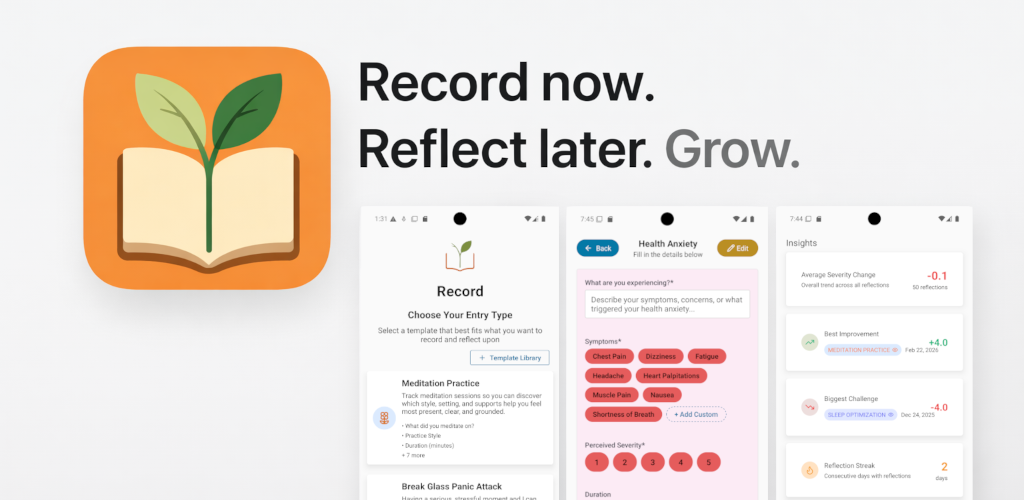
In Record Reflect Recover, the Productivity & Focus Tracking template is built for this. You log task type, environment, focus support, time block, distractions, and focus level in the moment, and choose when to reflect (30 minutes to 1 day). On reflection you rate how effective your focus techniques were, note what helped focus, and capture one change for next time. The template keeps the record–reflect loop explicit so you discover which environment and supports maximize deep work for you.
How the Record → Reflect method helps
The Record Reflect Recover app is built around record now, reflect later. For productivity and focus, that means: capture the work block when it’s fresh (task, environment, supports, time, distractions, focus level), then reflect at a set time to rate how effective your techniques were and what to change. That comparison - focus then vs effectiveness in hindsight - gives you feedback you can’t get in the moment, and over time you see which conditions support concentration and which don’t. It doesn’t replace discipline or good tools; it adds structure so you can track productivity habits and improve your focus patterns based on your own data.
Conclusion
Focus is fragile: in controlled experiments, even very short interruptions have been shown to substantially increase errors and reduce work quality, and we’re not always accurate about how focused we were. Tracking focus patterns - task type, environment, focus support, time block, distractions, and focus level - then reflecting later on how effective your techniques were and what helped, turns each block into data. Research on interruptions and on feedback during self-regulated work supports that understanding what disrupts you and what helps you refocus can improve behavioral focus and productivity. A productivity tracking journal or work focus journaling habit that uses “record now, reflect later” fits that evidence: it helps you discover your concentration patterns and productivity rhythms so you can design your environment and habits accordingly. For more on delayed reflection and clarity, see Why Reflecting Later Helps You Think More Clearly.
Frequently asked questions
What is a productivity tracking journal?
A productivity tracking journal is a place to log work blocks in the moment - task type, environment, focus support, time block, distractions, and focus level - and then reflect later on how effective your focus techniques were, what helped, and one change for the next block. It supports the record–reflect loop so you can spot concentration and productivity patterns.
How can I tell what helps my focus?
Record each block when it happens (task, environment, supports, distractions, focus level) and set a reflection reminder. When you reflect, rate how effective your focus techniques were and what helped most. Over time you’ll see which environments, supports, and task types correlate with higher effectiveness - your personal focus tracking method.
Do interruptions really affect work quality?
Yes. In controlled experiments, even brief interruptions increased error rates in sequence-based tasks, and in experimental studies, interruptions during complex, creative work (e.g., essay writing) significantly reduced both quality and output. Tracking what pulls you off-task and reflecting later on effectiveness helps you design strategies to reduce or buffer interruptions.
How do I track productivity without it taking forever?
Use short entries: task type, environment, focus support, time block, distractions, and a 1–5 focus rating. Set a reflection reminder (e.g., 30 minutes to 1 day). When you reflect, rate how effective your techniques were and note one change. A few minutes per block is enough to build useful productivity patterns.